- Japanese Fans: Two Shapes, One Origin
- Sensu: A Japanese Invention?
- Kawahori-ogi: Designs Fanned Back and Forth
- Uchiwa: The Enduring Rigid Form
- Modern Transformations
- Tea Ceremony: The Fans That Are Not Opened
- Mai-Ogi and Japanese Dance
- Fans From the Old Capital
- Marugame: Shikoku’s Bamboo Powerhouse
- Contemporary Japanese Fans
- Pack Light, Travel Deep
Japan will do more than tempt you if you enjoy beautiful things. It will ambush you with lacquer, bamboo, gold leaf and perfect packaging until you’re standing at the airport wondering how you ended up with another suitcase to check in.
If you’re short of luggage space but want to take craft pieces home, consider Japanese fans - flat, light and packed with history.
They take you from the ceremonial etiquette of the imperial court, to the battlefields of medieval Japan, through traditional performing arts and to the consumer culture of the masses.
Breeze-maker, ritual implement, dance partner and insect-swatter, the Japanese fan punches well above its weight (negligible).
Japanese Fans: Two Shapes, One Origin
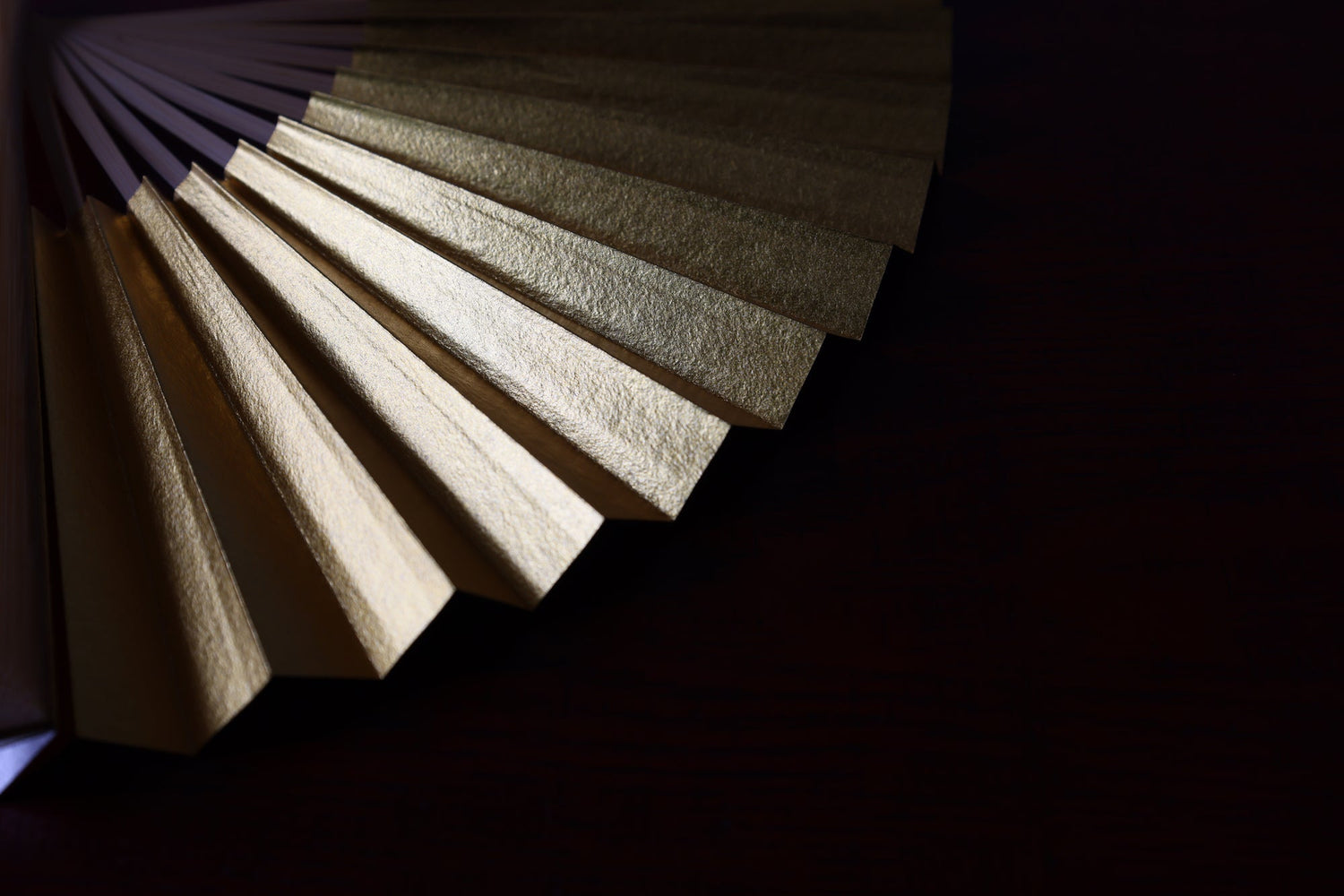
The sensu (扇子) is what most people picture when they think of Japanese fans. With slender ribs of bamboo or wood gathered at a pivot, then covered with paper or fabric, it flares out into a shape interpreted as expansion and growth, making sensu an auspicious addition to weddings and other celebrations.
The uchiwa (団扇) is the fixed fan: a handle plus a fan surface, usually paper over a bamboo or plastic rib structure. It’s the fan you see at summer festivals and in the hands of someone trying to cool sushi or coax a reluctant flame to produce dinner.
These two types can trace their lineage to a single ancestor: the sashiba. Originating in ancient China, this flat, long-handled fan was carried by attendants to shield high-ranking individuals from view while signaling their presence.
Archaeological evidence points to these fans being introduced to Japan during the Kofun period: clay figures shaped like sashiba have been found in 6th-century burial mounds in Gunma prefecture.
From this shared ancestor, Japanese fan culture branched out into two directions. One path preserved the rigid form and developed into the uchiwa. The other introduced folds: that innovation produced the sensu.
Sensu: A Japanese Invention?

Opinion remains divided on the exact origin of the folding fan but the evidence leans towards the sensu being invented in Japan.
The earliest Japanese folding fan - the hiogi - was made of cypress, constructed from the wooden slips used as writing tablets because wood was cheaper than paper, then a luxury item.
In the Heian period (794-1185), hiogi became essential elements of aristocratic life. Male courtiers used them in formal settings, sometimes in place of the ceremonial shaku baton, sometimes as a note pad for jotting down points of court etiquette.
For court ladies, there were decorated versions that they carried both as adornment and as screens to conceal their faces.
Kawahori-ogi: Designs Fanned Back and Forth
Following the hiogi came the kawahori-ogi, a folding fan covered with paper on one side. During the Kamakura period (1185-1333), folding fans were exported to China, where artisans developed double-sided paper versions. These were re-imported to Japan, influencing domestic production.
By the Muromachi period (1336-1573), sensu had expanded beyond court life. As etiquette systems matured, folding fans entered broader social use in ceremonies, seasonal exchanges and milestone events.
An iron fan was also invented; the samurai used the tessen as one of their weapons.
In the performing arts - Japanese dance, rakugo storytelling and Noh and kyogen theater - the sensu became indispensable. Its ability to open and close enabled it to mark boundaries, represent objects and extend the expressive range of gesture.
By the late Edo period (1603-1868), the sensu’s foldable practicality made it a popular accessory for everyday cooling. It had also become a canvas for painters, offering them the artistic challenge of framing landscapes, bird and flowers, or scenes from history or fiction within the shape of an open fan.
Uchiwa: The Enduring Rigid Form
The first uchiwa were made from wood, feathers and plant leaves. In their earliest forms, they were not primarily cooling devices. They were used for sweeping away impurities, signaling authority in ritual displays, and in prayer or divination.

By the 16th century, the prototype of the modern lightweight uchiwa - bamboo ribs and paper surfaces - had emerged. And, given that it was an age of civil war, it is no surprise that a battlefield version was also invented.
During the Sengoku era, uchiwa reinforced with lacquered materials or even iron plates were used by military commanders to signal their troops, display their family crest and, occasionally, to deflect stones and arrows.
In the Edo period (1603-1868), uchiwa became widely used by commoners for cooling, cooking - and fashion. Regional production centers formed, including Marugame in Shikoku.
Advances in woodblock printing led to the production of multi-color uchiwa featuring ukiyo-e prints and poems that reflected the trends of the time. More than a practical tool, the fan served as a medium of popular Japanese culture.
Modern Transformations
From the late 19th and into the 20th century, uchiwa were exported in large numbers, in particular, to the United States.
They also became a prominent form of advertising: the fans were distributed by merchants, shrines and temples, with names printed on the back and promotional messages on the front.
In the 20th century, uchiwa continued to reflect the changing times, bearing wartime propaganda in the 1930s-1940s and actor portraits in the 1950s-1960s.
In 1966, a Marugame manufacturer developed a polypropylene 'New Fan', dramatically increasing production. These plastic uchiwa remain common giveaway items at stations, concerts and sports venues.
Although electric fans and air conditioning have reduced their role in everyday life, uchiwa remain the quintessential summer fan, appearing at festivals, fireworks events and when people lounge on the veranda at home to the sound of cicadas.
Tea Ceremony: The Fans That Are Not Opened
Over the centuries, uchiwa have moved more into everyday life and broad popular use, while sensu carry stronger associations with courtly culture, gift-giving and traditional Japanese arts.
But this is the part that surprises many: at tea ceremony and incense appreciation gatherings, you carry a sensu but you do not fan yourself with it.

The sensu functions as a ceremonial boundary in the tea room. When greeting others, you set the fan in front of you to signal a line you will not cross - an expression of humility and consideration.
After the initial round of greetings, the fan is moved behind you, where it functions as a discreet seat marker.
Etiquette in Japan is often expressed through objects. The fan is used to show respect, to mark distance and to move through interactions gracefully - even if it never opens.
Mai-Ogi and Japanese Dance
In classical Japanese dance and kabuki theater, performers use special dance fans called mai-ogi (舞扇). They create lines of drama through movement: opening, closing, flipping, tilting, spinning and throwing.
Through its movements, a mai-ogi can depict the natural world - waves, the wind and the moon. And when it's opened to reveal a pattern of plum or cherry blossoms or autumn leaves, it sets the scene firmly within a season.

The fan can also represent objects. When it's opened, a sake cup or letter. When it's closed, a bottle, brush or sword.
Fans From the Old Capital
Kyoto’s association with the sensu rests on the oldest Japanese fan in existence: a hiogi discovered in an arm of a Toji temple statue during the 1870s.
Inscribed with the date Gangyo 1 (877 CE), the cypress slat fan has strengthened Kyoto’s longstanding claim to being the birthplace of the folding fan.
Today, the production of Kyo sensu remains centered in Kyoto and neighboring Shiga, with the processes still carried out by hand.
The fans are characterized by a high number of ribs and a relatively narrow fold width, giving them a dignified elegance whether closed or opened.
The insertion of slender bamboo ribs into washi paper is a delicate operation requiring considerable skill; experienced artisans can complete this process in just a few minutes, demonstrating techniques passed down through generations.
Kyoto’s sensu are further distinguished by refined decoration: gold and silver finishes, tasteful designs and skillfully painted surfaces.

Kyoto is also known for its uchiwa, which are usually made using the sashi-e method, in which the fan surface and the handle are produced separately and then joined.
Like Kyoto's sensu, Kyo uchiwa feature a high number of ribs in the fan.
Marugame: Shikoku’s Bamboo Powerhouse
A major center of fan production, Marugame city on Shikoku, one of Japan's four main islands, accounts for around 90% of the country’s uchiwa production.
A defining characteristic of the Marugame uchiwa is its structure. With its handle and ribs fashioned from a single piece of bamboo, the fan is engineered for strength and designed to survive real summer use.
The rise of Marugame uchiwa to nationwide popuarity can be traced back to the early 19th century, when pilgrims visiting the area saw fans stamped with the character for 'gold' - also a character in the name of a local shrine - and decided that this made the uchiwa auspicious souvenirs.
Contemporary Japanese Fans
Even when they lie still, Japanese fans are always moving.
You can see this in contemporary sensu and uchiwa that keep traditional techniques but shift the surface language: bolder graphics, modern illustrations and playful patterns.
This evolution is only natural. Flat, framed and created to be seen as much as used, fans have always invited artistic expression.
Pack Light, Travel Deep
In Japan, small things have a way of coming with large histories.
The uchiwa holds summer: fireworks, festivals, the feeling of air moving across skin when the day won’t give you a break. It also carries older layers - ritual display, wartime command and the sweeping away of misfortune.
The sensu holds ceremony and performance: a boundary in tea, a wave in traditional dance, a sword in kabuki.
They may be heavy with history but they won't tip your luggage over the weight limit at the airport check-in.
By Janice Tay