- From Hiruko to Ebisu-sama
- One of the Seven Lucky Gods
- Ebisu Festival Dates: Kansai vs Kanto
- Nishinomiya Shrine: Putting Money on a Tuna
- Imamiya Ebisu Shrine: Merchant Spirit in Osaka
- Kyoto Ebisu Shrine: 5-Day Festival - with Maiko
- The Charms of Lucky Bamboo
- Ebisu and Yebisu: The District that Beer Built
- Reeling in Good Luck
Born to creator gods, he should also have become a deity. But by the age of three, he still couldn't walk so his parents put him in a boat and set it adrift, rejecting the child they considered deformed. His name was Hiruko - Leech Child.
According to mythological accounts, Hiruko is the firstborn of Izanagi and Izanami, yet he's excluded from the official count of their offspring. The reason is given without elaboration: 'The child we bore was not good,' they said - and so, he was abandoned.
What becomes of Hiruko is not clearly stated in the ancient texts.
But another legend tells of a child who washed up ashore and who was taken in and raised by the people there. He became known as Ebisu, god of fishermen and protector of children.
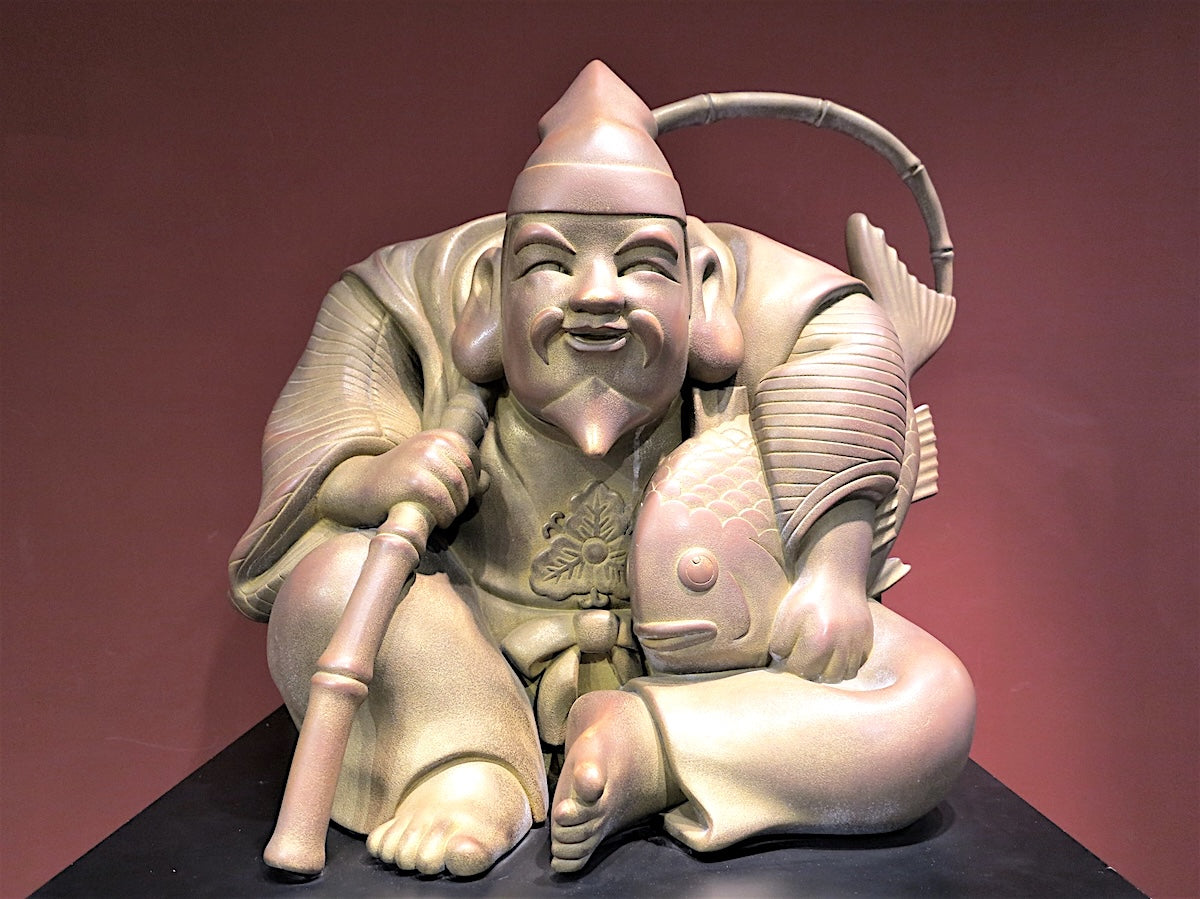
Ebisu is usually shown sitting - he still has trouble standing - but always smiling or laughing. Under one arm, he tucks a red sea bream, a fish of celebration. In the other hand, he holds a fishing rod as if good fortune is something you can reel in.
In the Kansai region, as the new year dawns and minds turn to profit, Ebisu shrines ring with a single call: shobai hanjo de sasa motte koi! If you wish to prosper, bring your bamboo!
From Hiruko to Ebisu-sama
Ebisu is both specific and slippery. Specific in iconography: the fishing rod, the sea bream, the smile. Slippery in identity: different shrines associate him with different deities.
One popular origin story links Ebisu to Hiruko, the castaway child of Izanagi and Izanami. Another links him to Kotoshironushi, a deity associated with oracles and, crucially, with fishing.
Ebisu’s blessings began with the sea: abundant catches and safe voyages. Over time, as markets and cities grew, those blessings migrated inland. Fishing became trade, catches became commerce - and a god of fishermen became a god of merchants.
Then there is the trait that makes Ebisu strangely relatable: he is said to be hard of hearing.
At Kyoto’s Ebisu Jinja, worshippers praying at the main hall may rap on a wooden wall as they leave - just to make sure that the god listens. At other shrines - Imamiya Ebisu Shrine in Osaka among them - drums are provided for the same purpose.
One of the Seven Lucky Gods
Ebisu doesn’t always travel solo. At times, he's shown crammed into a boat with six other deities - they look less like divine icons and more like friends having the time of their lives on a holiday cruise.
Worship of the Seven Gods of Good Fortune is thought to have originated in Kyoto during medieval times. Visiting seven shrines and temples associated with these deities - especially at New Year - was thought to confer great blessings.
Of the seven, only Ebisu (business prosperity) is of Japanese origin. Daikokuten (wealth and harvest), war god Bishamonten (protection and fortune) and lute-playing Benzaiten (learning and the arts) are Indian deities, while Fukurokuju (longevity, prosperity for descendants), Jurojin (longevity, wisdom) and big-bellied Hotei (happiness, marital harmony) hail from China.
Ebisu Festival Dates: Kansai vs Kanto
Festivals held across Japan in Ebisu's honor cluster around two numbers: the 10th and the 20th.
In the Kansai region, the big one is the 10th day of the first month, said to be Ebisu's birthday or the day that he heads out to sea. At major Ebisu shrines, Toka (10th day) Ebisu festivals are usually held over three days from January 9-11.
Over in the east of the country, in Kanto, Ebisu worship historically emphasized the 20th, with Hatsuka (20th day) Ebisu traditions kept alive at events such as Asakusa Shrine’s January 19-20 festival.
And then Kyoto, being Kyoto, adds its own twist: Ebisu festivals elsewhere are typically two- or three-day affairs but Kyoto’s Toka Ebisu lasts five days, from January 8-12.
The Kyoto shrine also holds a two-day festival in autumn that culminates on October 20: after months at sea, Ebisu is welcomed back.
Nishinomiya Shrine: Putting Money on a Tuna
If you want to see Ebisu worship distilled into pure motion, head to Nishinomiya Shrine in Hyogo prefecture at the start of the year.
The signature event of the Toka Ebisu festival there is the Lucky Man race: a sprint that begins the moment the shrine gate opens at around 6 am on January 10.
Runners surge down the 230m approach toward the main hall, some tripping and falling in their haste. The first three finishers to make it into the hall and the waiting arms of the shrine priests are designated that year’s fuku otoko, or lucky men: it is said that they receive great blessings for their achievement.

Another highlight is the dedication of a massive maguro. The tuna is displayed and visitors attempt to stick coins on its surface or tuck bills under its fins.
The logic? Well, if money sticks to the fish, it'll also stick to you through the year.
Imamiya Ebisu Shrine: Merchant Spirit in Osaka
Across western Japan, Ebisu is called Ebessan. The nickname signals affection - a god treated less like a distant authority and more like an elder who understands how daily life actually works.
Nowhere is that closeness more visible than at Imamiya Ebisu Shrine in Osaka. Each January, people flock to visit the shrine, which attracts about a million visitors for its Toka Ebisu festival.
The roots of the shrine lie deep in Osaka’s commercial past. At the time of the shrine's founding - 600 CE, according to the traditional account - it was located near the coastline, where markets popped up to facilitate the exchange of goods from the fields and the sea.
Ebisu was enshrined as the guardian of one such market but his role expanded and, as the city grew into a commercial center, Imamiya Ebisu Shrine became venerated as the protector of Osaka’s merchants.

That legacy is still visible during the festival, when commerce and devotion fold neatly into one another. People stroll around the stalls - there are about 700 - pray at the shrine, purchase lucky amulets and carry them back to shops and offices.
Another expression of Osaka’s mercantile culture during the festival is the Hoe-kago procession, a lively parade of palanquins and fuku musume - Lucky Maidens - that winds through a nearby shopping district.
The event grew out of a custom observed by geisha from Osaka’s Minami district, who would travel to the shrine in ornate palanquins, or kago, to pray for their patrons’ success.
In this city of commerce, you don’t have to pretend that you’re above money. You simply pray for a prosperous year, buy your lucky charms - and get back to work.
Kyoto Ebisu Shrine: 5-Day Festival - with Maiko
Toka Ebisu is considered the first major festival of the year in Kyoto, and it runs from January 8-12 in a five-day span that distinguishes the city's version from other regions' shorter runs.
Set near temples and geisha districts, the location of Kyoto's Ebisu Jinja has shaped its Toka Ebisu - most notably in the form of maiko.
People who buy bamboo branches at the shrine on January 11 can choose to receive them from gorgeously dressed apprentice geisha in a small, courtly exchange.
But the historical color begins on the first day of the festival. A yutate kagura ritual is performed on January 8 - a shrine maiden stands before a vat of boiling water and scatters it using bamboo leaves.
If you're lucky enough to be splashed, consider yourself protected from bad luck and ill health.
The Charms of Lucky Bamboo
But why did lucky bamboo - fuku-zasa - become the festival's must-buy item?
Its appearance suggests answers: bamboo grows straight upwards - auspicious for business growth - and stays green even in winter, a sign of resilience. As a bonus, it even resembles Ebisu's fishing rod.

What you attach to the branch matters as much as the branch itself. The talisman decorations vary by shrine but common motifs include:
- Koban (gold coins) for financial good fortune
- Sea bream for luck
- Treasure ships, storehouses and rice bales for prosperity and abundance
- Rakes to rake in good fortune.
Kyoto adds an origin story, suggesting that the custom may have been inspired by alcohol, thank-you gifts and a pun based on nyobo kotoba - court ladies' language. A coded speech that began to be used in the 14th century by women serving at the imperial court, many of its terms relate to food, clothing and everyday items.
This refined way of speaking later spread to the rest of the city and some words came to be used even by men.
In this speech, dumplings were called ishi-ishi, tofu, okabe, and alcohol, sasa - a word either formed by repeating the first syllable of sake or derived from the Chinese practice of referring to alcohol as 'bamboo leaves' - 'sasa' in Japanese.
So when breweries offered up barrels of sake at the Ebisu shrine, it thanked them with talismans made from another kind of sasa: bamboo leaves.
Ebisu and Yebisu: The District that Beer Built
Ebisu has another connection to alcohol: this time, in the form of beer.
In the late 19th century, beer in Japan was still in its infancy. One company sought to raise industry standards by importing brewing equipment from Germany and inviting brewmasters to Japan to oversee production.
For the brewery site, a sparsely developed area in Tokyo was chosen. Brewing required space, easy access to water and cool underground storage space. The former Mita aqueduct flowed through the area, supplying water, and the elevated land made it possible to excavate cellars.
Construction of a brewery there was completed in 1889 and the beer was given the auspicious name of Yebisu, using an older romanization in which the Japanese ‘e’ sound appeared as ‘ye’ - as in the once-common spelling ‘Yedo’ for Edo.
The brewery came first. The town followed.
What had been part of Meguro village began to reorganize itself around beer. As demand grew, a freight-only rail stop was opened in 1901 to ship Yebisu Beer and, in time, that stop became a passenger station: Ebisu Station.
Eventually, the name no longer referred only to a label on a bottle but also to a place where people lived and worked. It is one of the rare reversals in place-name history: unlike Bordeaux or Champagne, where the land lent its name to the drink produced there, here the drink named the land.
The brewery was relocated to Chiba prefecture in 1988 but brewing returned in another form in 2024 with the opening of Yebisu Brewery Tokyo, a combined museum, brewery and taproom that connects the city to its beer-making past.

That history also survives in sound.
If you pass through Ebisu Station, you hear it just before the train doors close. The departure melodies are inspired by music from the 1949 film noir The Third Man - music that, in Japan, became inseparable from Yebisu Beer through its use in television commercials.
Different platforms feature different arrangements, with distinct versions for the Yamanote Line’s inner and outer loops, the Saikyo Line and the Shonan–Shinjuku Line.
The jaunty jingle serves as a daily reminder that, even now, the neighborhood still hums to the tune of the beer that brought it blessings.
Reeling in Good Luck
Ebisu’s appeal is often explained in one line: he brings good fortune.
But that’s not enough of an explanation because plenty of gods do that.
Ebisu’s deeper pull is narrative. He is the abandoned child who returns in triumph. The castaway who becomes a household name. His physical impairments have not disappeared - he is still hard of hearing and prefers to sit rather than stand - but he carries them without bitterness.
That may be why Ebisu festivals feel so cheerful - they're infused with the spirit of a deity who's always smiling, always laughing, bringing blessings wherever he goes.
By Janice Tay