The decline of ukiyo-e
Japan’s history of woodblock printing doesn’t start and end with Hokusai – even though the sheer fame of his prints might make it seem like ukiyo-e simply ended with him.
Nevertheless, it’s true that the late 19th century witnessed a sharp decline in the old “pictures of the floating world.” The world that had sustained ukiyo-e was disappearing. The 1868 Meiji Restoration upended the Tokugawa caste system, liberalised the press, and ushered in Western technologies and visual media.
The most impactful of these on woodblock printing were cheap photography and lithography. These technologies could capture portraits and news more quickly and realistically than carved woodblocks, which media like newspapers and magazines enthusiastically embraced.
Traditional ukiyo‑e had always been a commercial and collaborative enterprise, its subjects the denizens of the pleasure quarters and entertainment industry. But as Meiji society embraced Westernisation, demand shifted from Edo-style celebrity pictures to news, advertising, and realistic imagery — all of which newer printing processes could do faster and better.
Many woodblock publishers closed down or pivoted. By the early 20th century, original ukiyo‑e production had slowed to a trickle, with reprints or tourist souvenirs largely replacing cutting‑edge designs.
Paradoxically, this was precisely when ukiyo‑e began to be recognized as “fine art” in Europe and the United States, fuelling the rise of Japonisme, and in turn, nurturing the creative spirits of Impressionist and Art Nouveau painters. But within Japan, the medium looked increasingly old-fashioned — at least, until a savvy publisher named Watanabe Shōzaburō revived it with a new strategy.

Reviving the woodblock print: the shin-hanga movement
Watanabe’s vision and export strategy
Watanabe Shōzaburō (1885–1962) is widely credited as the driving force behind shin‑hanga (‘new prints’), a movement during the Taishō and early Shōwa eras that revitalised ukiyo‑e for a modern, largely overseas audience.
After working for an export firm, he founded his own publishing house in 1906. By 1915, he was using the term ‘shin-hanga’ to distinguish his high‑quality woodblock prints from cheap reproductions and devalued mass‑market ukiyo‑e.
Watanabe’s brilliant insight was to retain the traditional collaborative production system — designer, carver, printer, publisher — but to apply it to fresh subject matter and refined techniques that would appeal to Western collectors. He commissioned artists to create prints of landscapes, bijin (beauties), birds‑and‑flowers, and genre scenes rendered with more naturalistic lighting, perspective, and atmospheric effects than classical ukiyo‑e.
At the same time, he enforced high standards in carving and printing, using multiple blocks and complex color gradations (bokashi). He also deliberately kept edition sizes limited, creating artificial scarcity and preserving the value of existing print runs.
Watanabe targeted foreign markets aggressively, exporting to the United States and Europe through galleries, world fairs, and department stores, while cultivating relationships with Western collectors and critics. This export‑driven strategy meant that many early shin‑hanga masterpieces left Japan soon after printing, noted today by collectors and museums tracing provenance.

Key shin‑hanga artists and themes
The shin‑hanga movement is best known through a core group of artists associated with Watanabe and other publishers:
- Kawase Hasui (1883–1957), famed for lyrical landscapes and townscapes — rain‑soaked streets, snow‑covered temples, quiet night scenes — that earned him the title ‘Poet of Travel.’ His prints for Watanabe, such as views of Tokyo and rural Japan, are now among the most collected shin‑hanga works.
- Ito Shinsui (1898–1972) and Hashiguchi Goyō (1880–1921), leading bijin‑ga (beauty) artists, created elegant portraits of modern women in kimono, combining ukiyo‑e line with subtle shading and Western ideas of modeling and individuality.
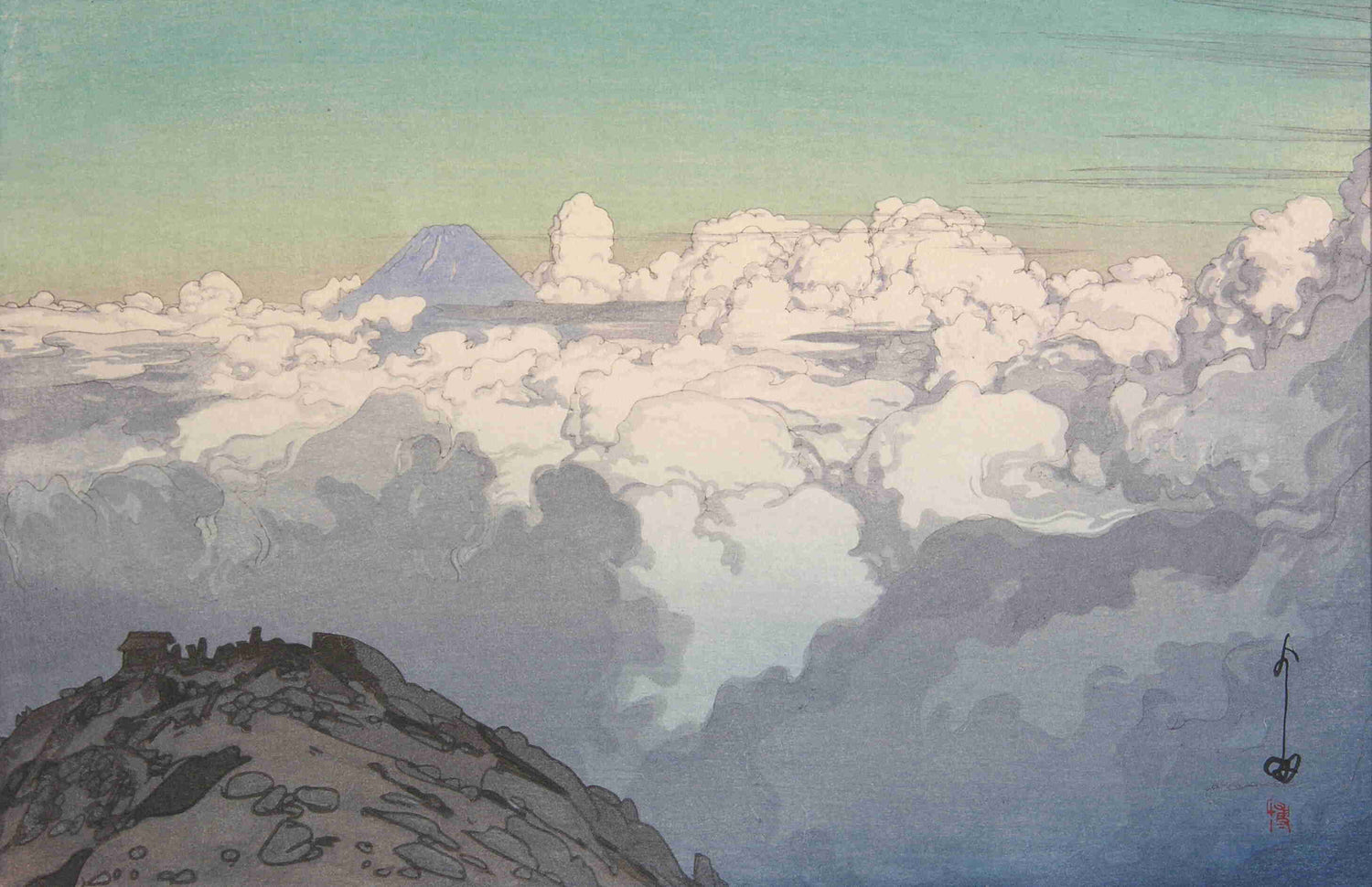
- Hiroshi Yoshida (1876–1950), who was both an artist and publisher, produced travel landscapes of Japan, Europe, and the United States, often personally supervising or participating in the printing process.
Print historians note that a single shin‑hanga landscape might require 10–20 separate blocks and print runs, especially when multiple bokashi gradations and special effects were used.
Despite the labour involved, Watanabe kept first-edition prices relatively modest to cater to middle-class Western collectors. This made shin-hanga an early form of affordable global art.

The legacy of shin-hanga
Shin‑hanga demonstrated that woodblock printing could still be a contemporary art form, not just a relic or a medium for cheap reproductions. It re‑energised the artisan networks of carvers and printers, and provided them with an economic basis to continue their craft.
Aesthetically, shin-hanga bridged Japanese and Western sensibilities — traditional formats and subjects, but with modern lighting, mood, and composition.
The shin-hanga movement waned after World War II, as tastes shifted, and offset printing and photography once again entered the popular sphere. It nevertheless left a rich legacy of prints that captured the mood and spirit of the first few decades of the 20th century.
Around the same time as the shin-hanga movement, however, another group of artists decided on a completely different course of action — they rejected the collaborative model entirely, asserting that the printmaker was to control every stage of the creative process.

Sōsaku‑hanga, or the rise of ‘creative prints’
The philosophy of jiga, jikoku, jizuri
The sōsaku‑hanga (‘creative prints’) movement emerged in the early 20th century as a counterpoint to both commercial ukiyo‑e and shin‑hanga. Its core principle was that the artist should be the sole creator of the work — conceiving, carving, and printing it personally — as a vehicle for self‑expression rather than commercial illustration. Slogans such as jiga (self‑drawn), jikoku (self‑carved), and jizuri (self‑printed) captured this ethos.
In contrast to the Edo‑period division of labour and Watanabe’s tightly controlled production line, sōsaku‑hanga artists emphasised experimentation and artistic autonomy. Forget technical polish — it was all about expressive individuality. They were influenced by Western ideas of the singular, “original” artist, and by broader Taishō‑era currents of individualism and liberal thought.

Onchi, Munakata, and the First Thursday Society
The printmaker Onchi Kōshirō (1891–1955) is often called the father of sōsaku‑hanga. Trained in design and book illustration, he created highly personal, sometimes abstract prints.
In 1939, he founded the First Thursday Society (Ichimokukai) — not to be confused with The Thursday Murder Club — a circle of artists who met monthly to critique each other’s work and promote creative printmaking. After the war, this group, along with artists such as Sekino Jun’ichirō and Yamaguchi Gen, helped bring sōsaku‑hanga to international attention through exhibitions and exchanges.
Another major figure, Munakata Shikō (1903–1975), developed a bold, expressionistic style using thick black lines and dynamic compositions, often depicting Buddhist themes and folklore. His works, hand‑carved and printed in small editions, epitomise the physical, material engagement sōsaku‑hanga artists had with their blocks.
Overall, sōsaku‑hanga prints could be rougher and more experimental than shin‑hanga, with visible carving marks, unconventional colours, and a willingness to embrace chance effects in printing. They were also harder to produce and monetise, which meant many artists supported themselves through book design, commercial work, or teaching.

So you want to collect woodblock prints?
Everyone likes to start with classic ukiyo-e. But as a new collector, 20th century woodblock prints are an under-rated, untapped resource. They offer that rare combination: genuine original works by important artists, from historically significant movements, at still-affordable price points.
According to auctioneers and dealers, while top Edo-period ukiyo-e can cost in the tens or hundreds of thousands of dollars, many shin‑hanga and sōsaku‑hanga prints are available in the low hundreds or even under 100 in secondary markets.
Furthermore, a 2026 market analysis estimates that around 90% of Japanese woodblock prints — many of them 20th‑century works — trade between roughly 50 and 1,000 USD, with only a small minority reaching five figures and above.
In other words, the field rewards careful looking and research — you might stumble across an entry-level original or fine 20th-century reprints for not very much at all. This is excellent for those who want to surround themselves with beautiful images rather than collect as investment — their relative affordability is a real bonus.

Where to begin, what to collect?
Here are some common starting points for new collectors:
- Shin‑hanga landscapes and cityscapes (Hasui, Yoshida, Tokuriki, Koitsu) for their immediate visual appeal and connection to traditional ukiyo‑e themes.
- Sōsaku‑hanga prints by mid‑century artists (Onchi, Munakata, Sekino, Kitaoka), which often carry lower edition numbers and a clear sense of the artist’s hand.
- Later 20th‑century and contemporary prints by artists working in traditional techniques but modern styles, often available through specialist galleries and print fairs.
Enthusiasts have reported building small collections of Kawase Hasui, Tsuchiya Kōitsu, Fumio Kitaoka, Sekino Jun’ichirō, and others by targeting mid‑range prints and lesser‑known designs while avoiding the most hyped works.
It’s useful to start out by frequenting reputable dealers, museum shops, or established auction sites that clearly distinguish original prints, posthumous re‑prints, and modern reproductions. Resources like ukiyo‑e.org are also helpful for research and signature identification.
For would-be collectors based in Japan, pounding the pavement by exploring print shops in districts like Kanda and Jimbochō in Tokyo, Kyoto handicraft centers, or museum shops in places like the Ukiyo‑e Museum in Matsumoto, are an excellent way to start.

Identifying valuable editions and later impressions
For both shin‑hanga and sōsaku‑hanga, print value depends heavily on edition, impression quality, and condition.
Early impressions, made when the blocks were fresh, are usually far more valuable than later pulls. Early impressions show:
- Sharp, crisp keyblock lines
- Rich, saturated colours
- Intact fine details (hair, textile patterns, foliage)
- Full expression of techniques like bokashi (subtle color gradation) or baren suji‑zuri (visible baren swirls)
Later printings, especially when editions run into the thousands, often exhibit:
- Softer, fuzzy lines from worn blocks
- Faded or uneven colors
- Lost or simplified details
- Occasional re‑cut blocks that don’t perfectly match the original design
For shin‑hanga, publisher seals and notations are crucial clues. Watanabe used different seals in different periods—such as pre‑earthquake “oval” or “大正” seals, a 6 mm “lifetime” seal (c. 1946–1957), and later Heisei‑era seals on postwar reprints. A Kawase Hasui design printed with a 6 mm lifetime seal can be worth five to ten times more than the same image with a modern reprint seal, even though both are “authentic” Watanabe woodblock prints.
Sōsaku‑hanga editions and signatures
In sōsaku‑hanga, the artist typically signs and numbers prints in pencil. Edition sizes are often small (sometimes under 50 or 100). Because the artist prints the work themselves, there is no separate publisher seal, but there may be date notations and series titles.
Collectors look for:
- Clear artist signature in pencil or brush
- Edition number (e.g., 7/50) when present
- Good registration (alignment) between colours
- Strong, intentional inking rather than patchy or faint impressions
For the collector, there’s a real satisfaction in knowing that the artist designed, carved, and printed each impression personally. This ‘total authorship’ even makes some collectors more inclined to pay for such prints, even when shin-hanga landscapes might be more ‘aesthetically pleasing.’
Condition and provenance
For both types of prints, condition remains non‑negotiable for value. Specialists highlight:
- Minimal foxing (brown spots), stains, or toning
- Intact margins with original publisher seals and watermark (where applicable)
- No trimming that cuts into signatures or seals
- Absence of backing papers or acidic mats that can damage the sheet
Provenance — documentation of previous ownership, museum deaccession labels, or illustration in catalogues — adds further value and authenticity, especially for high‑end prints.

A shortlist of practical tips for collectors
-
Start with what you love, not what’s hottest. Many collectors report beginning with famous names like Hasui or Yoshida but later shifting toward lesser‑known artists and sōsaku‑hanga as their eye matures. Buy images you genuinely want to live with, since the market can be slow and resale is not guaranteed.
-
Learn to read seals and signatures. Get comfortable with publisher seals, date notations, and artists’ signatures and using online databases (ukiyo‑e.org, dealer reference pages) to verify attributions and edition periods. Misattribution and confusion between shin‑hanga and later reproductions are common pitfalls.
-
Accept that resources are patchy. English‑language references on shin‑hanga are scarce, often outdated. Valuation is easy to get wrong. To get around this, use a mix of reference books, reputable dealers, and auction results rather than any single price guide.
-
Use dealers and auctions strategically. Try watching specialty auctions (e.g., Artelino, major print dealers) to understand price ranges, while also exploring museum shops and contemporary publishers like Adachi for high‑quality reprints if the budget is tight.
-
Be realistic about budget and condition. Entry‑level prints, especially later impressions or less famous artists, are affordable, but top‑tier works by Hasui, Goyō, Yoshida, Onchi, or Munakata can be expensive and heavily competed for. Practice patience and careful inspection; when in doubt, pass on compromised examples.